Friday, June 24, 2016

Important Of Proximity Card In The Business Sectors!


http://www.cardsandkeyfobs.com/
ISO proximity cards 

Presently, each and every business needs a complete solution through which they can monitor and track employee in and out details. Now, if you have more than 100 employees in your company, then definitely you need a good way through which you can track employee’s attendance details. Currently, advance technology creates several advanced ways through which you can monitor and track the record successfully.  If you are looking for this kind of system for your company, you can choose Proximity Cards for this purpose. This card contains a power chip where the identification of a particular person is stored. And once get powered, the card convey the code to the reader.
There are several kinds of cards available in the market. You have to choose a card as per your organization need and requirements. The ISO printable cards contain all the information related to those particular employees and their company details. There are several cards which contain company logo, employee name, address, blood group, date of birth, contact number etc.  This kind of cards can be used as a one type of advertising. And they also promote the business in both design and words.  A well printed card is the one that employee wants to hang onto or carry always.
Proper Printable Cards always stored different information in a micro cheap and it also creates brand awareness. A business card can symbolize honesty, trustworthiness and consistency that a business or industry person would attach his number and name to a physical card.  If you are looking for a first impression in the business world, then a printable card for business is very essential. It helps to provide a long lasting impression.  It also shows your company’s reputation and object of your business.
The Proximity keyfobs is another way to stores business data in the card. It is used for contactless integrated circuit technology to transfer data from a distance.  Presently, there are several online companies who offer different types of cards for business purposes. All cards are advanced and make your process more simple and easy.  It’s a way through which you can convert important data to a secure place or it also shows your employees proper identity. All these cards provide secure process through which your business can gain a good reputation and brand awareness. So, choose a best card service provider through the net after profound research through the net. It’s a best and safest way.


Thursday, June 9, 2016

Top 10 Greatest Empires In History

Top 10 Greatest Empires In History
FREIKORPTRASHER JUNE 22, 2010

Share toRedditShare toArtoShare toTumblrShare toGoogle BookmarkMore AddThis Share optionsMore
The definition of an empire is: when a single entity has supreme rule and power over a vast area of territory, which consists of peoples of different ethnicity and nationality. This list is based on the influence, longevity and power of the various empires, and, as you will see, it contains at least one or two entries that may strike some as controversial. My one requirement for this list is that the empire must have been ruled – for at least a majority of the time – by an emperor or king. This excludes modern so-called empires such as the United States and Soviet Union. The entries here are listed roughly by influence and size.
10
Ottoman Empire
Ottoman-Empire-Public-Demo
At the height of its power (16th–17th century), the Ottoman Empire spanned three continents, controlling much of Southeastern Europe, Western Asia and North Africa. It contained 29 provinces and numerous vassal states, some of which were later absorbed into the empire, while others were granted various types of autonomy during the course of centuries. The empire was at the center of interactions between the Eastern and Western worlds for six centuries. With Constantinople as its capital city, and vast control of lands around the eastern Mediterranean during the reign of Suleiman the Magnificent (ruled 1520 to 1566), the Ottoman Empire was, in many respects, an Islamic successor to the Eastern Roman (Byzantine) Empire.
9
Umayyad Caliphate
281780073 F6Cf2F106F
The Umayyad Caliphate was the second of the four Islamic caliphates (systems of governance), established after the death of Mohammed. It was ruled by the Umayyad dynasty, whose name derives from Umayya ibn Abd Shams, the great-grandfather of the first Umayyad caliph. Although the Umayyad family originally came from the city of Mecca, Damascus was the capital of their Caliphate. Eventually, it would cover more than five million square miles, making it the largest empire the world had yet seen, and the fifth largest contiguous empire ever to exist. The Umayyads established the largest Arab-Muslim state in history. From the time of Mohammed until 1924, successive and contemporary caliphates were held by various dynasties – the last being the Ottoman Empire (above).
8
Persian Empire
or Achaemenid Empire
Achaemenid Empire
Babylonian, Akkadians, Assyrians, Sumerians, Hitites, Bactrians, Scythians, Parthians, Medes, Elamites, Egyptians, Ethiopians… Before the Romans, there were the Persians. They basically unified the whole of Central Asia which consisted of a lot of different cultures, kingdoms, empires and tribes. It was the largest empire in ancient history. At the height of its power, the empire encompassed approximately 8 million km2. The empire was forged by Cyrus the Great, and spanned three continents: Asia, Africa and Europe.
7
Byzantine Empire
Hagia Sophia West View
The Byzantine Empire, or Eastern Roman Empire, was the Roman Empire during the Middle Ages, centered on the capital of Constantinople, and ruled by emperors in direct succession to the ancient Roman emperors. It was called the Roman Empire, and also Romania. During its existence, of over a thousand years, the Empire remained one of the most powerful economic, cultural and military forces in Europe, despite setbacks and territorial losses, especially during the Roman–Persian and Byzantine–Arab Wars. The Empire received a mortal blow in 1204 by the Fourth Crusade, when it was dissolved and divided into competing Byzantine Greek and Latin realms. Despite the eventual recovery of Constantinople and re-establishment of the Empire in 1261, under the Palaiologan emperors, successive civil wars in the fourteenth century further sapped the Empire’s strength.
6
Han Dynasty
Maphan
During the Chinese period of warring states, the whole of China was embroiled in a civil war as the different kingdoms within it battled it out with each other in the quest for supremacy. In the end, the Qin State won, and gobbled up the whole of China, with 40 million people under it’s control. The Qin Dynasty didn’t last long, and soon it went to the Han, which eventually controlled China for close to 400 years. The period of the Han Dynasty is considered a golden age in Chinese history in terms of scientific achievement, technological advance, economic, cultural and political stability. Even to this day, most Chinese people refer to themselves as the Han people. Today, the “Han people” is considered the largest single ethnic group in the world.
5
British Empire
Britishempire
At it’s greatest extent, the British empire was known as the largest empire in history, as it covered more than 13,000,000 square miles, which is approximately a quarter of the Earth’s total land area, and controlled more than 500 million people – again a quarter of the world’s population. As a result, the legacy it imprinted on these conquered lands is tremendous in terms of political reform, cultural exchanges and way of life. The English language, which it spread, is the second most-widely spoken language in the world today, and many linguistics agree that English is the defacto standard language of the world. The British empire is definitely one of the most influential empires ever to have existed in human history.
4
Holy Roman Empire
880164-Holy Roman Empire Coat Of Arms Super
During the middle ages, they were considered the “superpower” of their time. At it’s height, the Holy Roman Empire consisted of eastern France, all of Germany, northern Italy and parts of western Poland. Despite being relatively small in terms of Empires, its influence on the history of central Europe is still felt today. Incredibly the Empire lasted from the early middle ages ages to the 19th century. The Empire was formally dissolved on 6 August 1806 when the last Holy Roman Emperor, Francis II (later Francis I of Austria), abdicated following a military defeat by the French under Napoleon. Upon its collapse, the following nations emerged: Switzerland, Holland, the Austrian Empire, Belgium, the Prussian Empire, Principality of Liechtenstein, Confederation of the Rhine and the first French Empire.
3
The Russian Empire
Screen Shot 2010-06-21 At 4.49.40 Pm
The Russian Empire was a state that existed from 1721 until the Russian Revolution of 1917. It was the successor to the Tsardom of Russia, and the predecessor of the Soviet Union. It was the second largest contiguous empire in world history, surpassed only by the Mongol Empire, and the third largest empire behind the British Empire and the Mongol Empire. At one point in 1866, it stretched from eastern Europe, across Asia, and into North America.
2
Mongol Empire
Reezu 2737
It all started when Temujin (who was later known as Genghis Khan), vowed in his youth to bring the world to his feet. He almost did. His first act was unifying the scattered Mongolian tribes. Then he set his sight on China, and the rest is history. From Vietnam to Hungary, the Mongol Empire is the largest contiguous empire in the history of mankind. Unfortunately for them, their empire was too big to be controlled, and there was no unity among the different cultures. The Mongols were fearless and ruthless fighters, but had little experience in administration. The image of the mongols as a brutal and savage people is renowned through history.
1
Roman Empire
13602 Fall Of The Roman Empire Screen 5-1
At first they were ruled by divine kings, then they became a republic (perhaps their greatest period) before finally becoming an empire. How a group of farmers, who started off fending wolves to protect their livestock, eventually became the greatest empire in all history is the stuff of legends. Coupled with an excellent military and administrative system, the Roman Empire, or rather ancient Rome, is also one of the longest-lasting. Counting from its founding to the fall of the Byzantine empire, ancient Rome lasted for a whopping 2,214 years!
Ancient Rome contributed greatly to the development of law, war, art, literature, architecture, technology, religion and language in the Western world. In fact many historians consider the Roman Empire to be a perfect empire – influential, fair, long-lasting, big, well defended and economically advanced. The influence of the Roman Empire is felt to this day, if for no other reason than the influence on the Catholic Church, which took much of its administrative nous and pageantry from it.
Share toRedditShare toArtoShare toTumblrShare toGoogle BookmarkMore AddThis Share optionsMore


Thursday, December 3, 2015

Ghost hunting


For other uses, see Ghost hunters.
"Paranormal investigation" and "paranormal investigator" redirect here. For other uses, see paranormal.
"Ghost hunt" redirects here. For the light novel series and its adaptations, see Ghost Hunt.

A ghost hunter taking a reading with an EMF meter

Traditional techniques such as conducting interviews and researching the history of a site are also employed. Some ghost hunters refer to themselves as a paranormal investigator.[1] Ghost hunting has been criticized for its absence of scientific method; no scientific body has been able to confirm the existence of ghosts.[2][3] Ghost hunting is considered a pseudoscience by a majority of educators, academics, science writers, and sceptics.Ghost hunting is the process of investigating locations that are reported to be haunted by ghosts. Typically, a ghost hunting team will attempt to collect evidence that they see as supportive of paranormal activity. Ghost hunters often use a variety of electronic equipment, for example: the EMF meter; digital thermometer; handheld and static digital video cameras, such as thermo graphic (or infrared) and night; digital audio recorder; and computer.


Popularity[edit]
The Internet, films (like Ghostbusters) and television programs (like Most Haunted, Ghost Hunters, The Other sliders and Ghost Adventures), along with the increasing availability of high-tech equipment are thought to be partly responsible for the boom in ghost hunting. Despite its lack of acceptance in academic circles, the popularity of ghost-hunting reality TV shows have influenced a number of individuals to take up the pursuit.[12]
Small businesses offering ghost-hunting equipment and paranormal investigation services have increased in the last decade. Many offer electromagnetic field (EMF) meters, infrared motion sensors and devices billed as "ghost detectors". The paranormal boom is such that some small ghost-hunting related businesses are enjoying increased profits through podcast and web site advertising, books, DVDs, videos and other commercial enterprises.[13]
One ghost-hunting group reports that the number of people taking their tours has tripled, jumping from about 600 in 2006 to 1,800 in 2008. Another says its membership has doubled. Others point to increased traffic on their websites and message boards as an indication that ghost hunting is becoming more accepted. Participants say that ghost hunting allows them to enjoy the friendship of like-minded people and actively pursue their interest in the paranormal. James Willis, founder of The Ghosts of Ohio group says that his membership has grown to 30 members since it was founded in 1999 and includes both true believers and total skeptics. Willis says his group is "looking for answers, one way or another" and that skepticism is a prerequisite for those who desire to be "taken seriously in this field."[12]
Author John Potts says that the present day pursuit of "amateur ghost hunting" can be traced back to the Spiritualist era and early organizations founded to investigate paranormal phenomena, like London's The Ghost Club and the Society for Psychical Research, but that it is unrelated to academic parapsychology. Potts writes that modern ghost hunting groups ignore scientific method and instead follow a form of "techno-mysticism".[11]
The popularity of ghost hunting has led to some injuries. Unaware that a "spooky home" in Worthington, Ohio was occupied, a group of teenagers stepped on the edge of the property to explore. The homeowner fired on the teenagers automobile as they were leaving, seriously injuring one.[14] A woman who was hunting for ghosts was killed in a fall from a University of Toronto building.[15]
An offshoot of ghost hunting is the commercial ghost tour conducted by a local guide or tour operator who is often a member of a local ghost-hunting or paranormal investigation group. Since both the tour operators and owners of the reportedly haunted properties share profits of such enterprises (admissions typically range between $50 and $100 per person), some believe the claims of haunting are exaggerated or fabricated in order to increase attendance.[16] The city of Savannah, Georgia is said to be the American city with the most ghost tours, having more than 31 as of 2003.[17][18]
Belief statistics[edit]
According to a survey conducted in October 2008 by the Associated Press and IPOs, 34 percent of Americans say they believe in the existence of ghosts.[12] Moreover, a Gallup poll conducted on June 6–8, 2005 showed that one-third (32%) of Americans believe that ghosts exist, with belief declining with age.[19][20] Having surveyed three countries (the United States, Canada, and Great Britain), the poll also mentioned that more people believe in haunted houses than any of the other paranormal items tested, with 37% of Americans, 28% of Canadians, and 40% of Britons believing.[20][21]
In 2002, the National Science Foundation identified haunted houses, ghosts, and communication with the dead among pseudoscientific beliefs.[5]
Skepticism[edit]
Many ghost-hunting groups say they find evidence of something they can't explain through scientific or natural means, yet critics question ghost-hunting's methodology, particularly its use of instrumentation, as there is no scientifically proven link between the existence of ghosts and cold spots or electromagnetic fields. According to skeptical investigator Joe Nickel, the typical ghost hunter is practicing pseudoscience.[22] Nickel says that ghost hunters often arm themselves with EMF meters, thermometers that can identify cold spots, and wireless microphones that eliminate background noise, pointing out the equipment being used to try to detect ghosts is not designed for the job. "The least likely explanation for any given reading is it is a ghost," maintains Nickell. Orbs of light that show up on photos, he says, are often particles of dust or moisture. "Voices" picked up by tape recorders can be radio signals or noise from the recorder and EMF detectors can be set off by faulty wiring or microwave towers.[12]
According to investigator Benjamin Radford most ghost hunting groups including The Atlantic Paranormal Society make many methodological mistakes. "After watching episodes of Ghost Hunters and other similar programs, it quickly becomes clear to anyone with a background in science that the methods used are both illogical and unscientific". Anyone can be a ghost investigator, "failing to consider alternative explanations for anomalous ... phenomena", considering emotions and feelings as "evidence of ghostly encounters". "Improper and unscientific investigation methods" for example "using unproven tools and equipment", "sampling errors", "ineffectively using recording devices" and "focusing on the history of the location...and not the phenomena". In his article for Skeptical Inquirer Magazine Radford concludes that ghost hunters should care about doing a truly scientific investigation "I believe that if ghosts exist, they are important and deserve to be taken seriously. Most of the efforts to investigate ghosts so far have been badly flawed and unscientific --- and, not surprisingly, fruitless." [8]
Although some ghost hunters believe orbs are of supernatural origin, skeptic Brian Dunning says that they are usually particles of dust that are reflected by light when a picture is taken, sometimes it may be bugs or water droplets. He contends that "there are no plausible hypotheses that describe the mechanism by which a person who dies will become a hovering ball of light that appears on film but is invisible to the eye." He does not believe there is any science behind these beliefs, if there were then there would be some kind of discussion of who, what and why this can happen. In his investigations he can not find any "plausible hypothesis" that orbs are anything paranormal.[23]
Science writer Sharon Hill reviewed over 1,000 "amateur research and investigation groups" (ARIGs), writing that "879 identified with the category of “ghosts”. Hill reports that many groups used the terms “science” or “scientific” when describing themselves, however "they overwhelmingly display neither understanding of nor adherence to scientific norms".
"ARIGs often promote their paranormals viewpoint as scientifically based, especially in community presentations or lectures at educational facilities. While scientifically minded observers can readily spot the anemic and shoddy scholarship of popular paranormal investigation, the public, unaware of the fundamental errors ARIGs make, can be persuaded by jargon and “science” symbols."
Hill sees the supernatural bias of such groups as an indication of how "far removed ARIG participants really are from the established scientific community".[7]
Methods and equipment[edit]

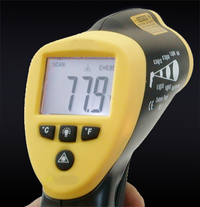
A handheld infrared thermometer of the type used by some ghost hunters
Ghost hunters use a variety of techniques and tools to investigate alleged paranormal activity.[24] While there is no universal acceptance among ghost hunters of the following methodologies, a number of these are commonly used by ghost hunting groups.[25]
•       Still photography and video: using digital, night vision, infrared, and even disposable cameras.
•       EMF meter: to detect possibly unexplained fluctuations in electromagnetic fields.
•       Tablet PC: to record data, audio, video and even environmental fluctuations such as electromagnetic fields.[25]
•       Ambient temperature measurement: using thermographic cameras, thermal imaging cameras, infrared thermometers, and other infraredtemperature sensors. It should be noted that all of these methods only measure surface temperature and not ambient temperature.[26]
•       Digital and analog audio recording: to capture any unexplained noises and electronic voice phenomena (EVPs), that may be interpreted as disembodied voices.
•       Compass: some ghost hunters used compass to determine the location of paranormal spot similar like EMFs.
•       Geiger counter: to measure fluctuations in radiation.
•       Live paranormal investigations which Np paranormal conduct on livestream. To capture live paranormal activity
•       Infrared and/or ultrasonic motion sensors: to detect possible anomalous movement within a given area, or to assist in creating a controlled environment where any human movement is detected.
•       Air quality monitoring equipment: to assess the levels of gases such as carbon monoxide, which are thought to contribute to reports of paranormal activity.
•       Infrasound monitoring equipment: to assess the level of sound vibrations.
•       Dowsing rods: usually constructed of brass and bent into an L-shape.
•       Psychics, mediums, or clairvoyants: trance mediums or "sensitive" individuals thought to have the ability to identify and make contact with spiritual entities.
•       Demonologists, exorcists, and clergy: individuals who may say prayers, give blessings, or perform rituals for the purpose of cleansing a location of alleged ghosts, demons,poltergeists, or "negative energy."
•       Lights out: according to ghost hunting enthusiast websites, many ghost hunters prefer to conduct their investigations during "peak" evening hours (midnight to 4 a.m.).
•       Ghost Box: an electronic device that some ghost hunters claim allows communication with spirits.
•       Interviews: collecting testimony and accounts about alleged hauntings.
•       Historical research: researching the history behind the site being investigated.
•       A Ouija board to communicate with spirits


Post-modern (1970–present)


The ghost of a pirate, from Howard Pyle's Book of Pirates (1903)
The 1970s saw screen depictions of ghosts diverge into distinct genres of the romantic and horror. A common theme in the romantic genre from this period is the ghost as a benign guide or messenger, often with unfinished business, such as 1989's Field of Dreams, the 1990 film Ghost, and the 1993 comedy Heart and Souls.[102] In the horror genre, 1980's The Fog, and the A Nightmare on Elm Streetseries of films from the 1980s and 1990s are notable examples of the trend for the merging of ghost stories with scenes of physical violence.[101]
Popularised in such films as the 1984 comedy Ghostbustersghost hunting became a hobby for many who formed ghost hunting societies to explore reportedly haunted places. The ghost hunting theme has been featured in reality television series, such as Ghost Adventures,Ghost HuntersGhost Hunters InternationalGhost LabMost Haunted, and A Haunting. It is also represented in children's television by such programs as The Ghost Hunter and Ghost Trackers. Ghost hunting also gave rise to multiple guidebooks to haunted locations, and ghost hunting "how-to" manuals.
The 1990s saw a return to classic "gothic" ghosts, whose dangers were more psychological than physical. Examples of films from this period include 1999's The Sixth Sense and The Others.
Asian cinema has also produced horror films about ghosts, such as the 1998 Japanese film Ringu (remade in the US as The Ring in 2002), and the Pang brothers' 2002 film The Eye.[103] Indian ghost movies are popular not just in India, but in the Middle East, Africa, South East Asia, and other parts of the world. Some Indian ghost movies such as the comedy / horror film Chandramukhi have been commercial successes, dubbed into several languages.[104]
In fictional television programming, ghosts have been explored in series such as SupernaturalGhost Whisperer, and Medium.
In animated fictional television programming, ghosts have served as the central element in series such as Casper the Friendly Ghost,Danny Phantom, and Scooby-Doo. Various other television shows have depicted ghosts as well. (See also List of ghosts#Popular cultureand Category:Fictional ghosts.

East and Central Asia


Further information: Preta

China

An image of Zhong Kui, the vanquisher of ghosts and evil beings, painted sometime before 1304 A.D. byGong Kai
There are many references to ghosts in Chinese culture. Even Confucius said, "Respect ghosts and gods, but keep away from them."[89]
The ghosts take many forms, depending on how the person died, and are often harmful. Many Chinese ghost beliefs have been accepted by neighboring cultures, notably Japan and southeast Asia. Ghost beliefs are closely associated with traditional Chinese religion based on ancestor worship, many of which were incorporated in Taoism. Later beliefs were influenced by Buddhism, and in turn influenced and created uniquely Chinese Buddhist beliefs.
Many Chinese today believe it possible to contact the spirits of their ancestors through a medium, and that ancestors can help descendants if properly respected and rewarded. The annual ghost festival is celebrated by Chinese around the world. On this day, ghosts and spirits, including those of the deceased ancestors, come out from the lower realm. Ghosts are described in classical Chinese texts as well as modern literature and films.
A recent article in the China Post stated that nearly eighty-seven percent of Chinese office workers believe in ghosts, and some fifty-two percent of workers will wear hand art, necklaces, crosses, or even place a crystal ball on their desks to keep ghosts at bay, according to the poll.

Day to Day Pigeon Growth 1 day to 1-hour flying, Pigeon fly training, কবুতর উড়ানো প্রশিক্ষণ Part-2

Pakistani Highflyer pigeon Day to Day Pigeon Growth 1 day to 1-hour fly training Kaldom pigeon baby 0 days to 1-hour fly training, কালদম কব...